Comprehensive Technical, Engineering, and Economic Evaluation of Geomembrane Systems in Modern Infrastructure
Sustainable development in the fields of civil engineering, water resource management, and environmental protection requires the utilization of advanced technologies capable of creating impermeable barriers against fluids and polluting gases. Geomembranes, as a vital member of the large geosynthetics family, are continuous polymeric sheets recognized as a reliable barrier in geotechnical and environmental projects due to their extremely low permeability. Originally introduced in the 1930s as PVC pond liners, advancements in polymer synthesis have turned them today into a global standard in landfill, mining, and water storage industries. The fundamental difference between geomembranes and other related products, such as geotextiles, lies in their absolute impermeability; while geotextiles are designed for filtration and drainage, geomembranes are engineered to create a sustainable barrier against even the smallest gas and liquid molecules.
Analysis of Polymer Structure and Chemical Fundamentals of Geomembranes
The physical performance and long-term durability of any geomembrane are directly related to the molecular structure of the base polymer and its chemical additive packages. The polymers used in this industry are mainly based on thermoplastics and elastomers, each offering unique characteristics for specific applications.
High-Density Polyethylene (HDPE) and Impermeability Mechanism
High-Density Polyethylene, abbreviated as HDPE, is the most widely used material in geomembrane production for large-scale environmental projects. The molecular structure of HDPE consists of long linear chains that, due to the absence of extensive side branches, pack together with very high density. This high density leads to the creation of a dense crystalline network whose density varies. From an engineering perspective, this compact structure renders these sheets impermeable.
In addition to the base polymer, 97% of the weight of these sheets consists of polyethylene resin, and about 2% to 3% comprises carbon black, whose primary function is to protect the polymer structure from degradation caused by ultraviolet (UV) radiation. The presence of antioxidants and thermal stabilizers in the HDPE formulation ensures that polymer oxidation processes, which lead to sheet embrittlement and cracking, are delayed for decades.
Linear Low-Density Polyethylene (LLDPE) and Structural Flexibility
In cases where flexibility takes priority over rigidity, LLDPE is the preferred option. This polymer possesses short side branches that prevent the complete crystallization of the chains, resulting in a product with lower density (between $0.915\text{ to }0.930\text{ g/cm}^3$) and greater flexibility. This feature allows LLDPE to elongate up to more than 700% of its original length without tearing under tensile stresses caused by differential ground settlement in landfills or water reservoirs. Unlike HDPE, which is susceptible to stress cracking under high pressures, LLDPE exhibits outstanding resistance to this type of mechanical failure.
Polyvinyl Chloride (PVC) and the Role of Plasticizers
PVC geomembranes are produced through the calendering process and, due to the use of plasticizers in their compound, possess the highest level of flexibility among all types of geomembranes. Owing to their high pliability, these sheets easily conform to uneven surfaces and sharp angles in tunnels and construction foundation pits. However, one of the technical challenges of PVC is the potential migration and volatilization of plasticizers over time, which can lead to a reduction in the sheet's flexibility and useful lifespan.
Synthetic Elastomers: EPDM and Resistance to Harsh Conditions
EPDM is a synthetic rubber that, due to its saturated chemical bonds, is considered the most resistant type of geomembrane against ozone and direct sunlight exposure. This material maintains its physical stability over a very wide temperature range (from -40 to +100 °C). Due to its elastomeric nature, these sheets possess the capability of recovery after load removal; however, higher production costs and difficulties in joint seaming (requiring adhesive tapes instead of thermal welding) have restricted their application to specialized projects.
Comparison of Physical and Chemical Specifications of Geomembrane Types
In the table below, the key characteristics of various polymers used in the geomembrane industry are compared based on international standards:
Mechanical Properties and Performance Test Standards
Engineering design with geomembranes requires a deep understanding of the behavior of these materials under static and dynamic loads. To guarantee quality, each geomembrane roll must undergo rigorous testing, which is primarily defined by ASTM and GRI standards.
Tensile Strength and Behavior at Yield Point
The tensile strength of geomembranes is divided into yield strength and break strength. In semi-crystalline polymers like HDPE, exceeding the yield point signifies permanent plastic deformation and thinning of the layer, which can compromise impermeability. Sheet thickness plays a decisive role in this resistance; thus, thicker sheets (e.g., 2.0 mm) are essential to withstand heavy loads in mining and landfills.
Puncture and Tear Resistance
Puncture is one of the most common causes of geomembrane failure during installation or operation. Static puncture resistance is evaluated using a cylindrical probe by measuring the force required to puncture the sheet. Factors such as subgrade roughness, the presence of sharp stones, and the hydrostatic pressure of the overlying fluid increase the puncture potential. For this reason, the use of protective geotextiles as a cushioning layer beneath the geomembrane has become an engineering requirement in critical projects.
Environmental Stress Crack Resistance (ESCR)
Stress cracking is the sudden, brittle failure of a polymer at stresses below its ultimate tensile strength, which is accelerated in the presence of chemical agents. This phenomenon is more frequently observed in HDPE due to its high crystallinity. According to the GRI-GM13 standard, high-quality geomembranes must demonstrate at least 500 hours of resistance in the Single-Point Notched Constant Tensile Load (NCTL) test to verify their durability against long-term loads.
Oxidative Stability and Oxidation Induction Time (OIT)
The lifespan of geomembranes depends on the stability of their antioxidant system. The OIT test measures the time it takes for the polymer to oxidize at a high temperature (usually 200 °C) in a pure oxygen environment. A decrease in OIT over time indicates the consumption of protective additives. Once these additives are depleted, the polymer enters a rapid degradation phase and loses its mechanical properties.
Analysis of Strategic Applications in Different Industries
Due to their high versatility, geomembranes play a role in a wide range of infrastructural projects. Each industry requires specific technical specifications that influence material selection.
Waste Management and Groundwater Resource Protection
In the construction of modern landfills, the geomembrane acts as the final liner barrier to prevent toxic leachate from seeping into soil layers and groundwater aquifers. Double liner systems, which include two geomembrane layers with a leak detection system between them, are mandatory for hazardous and nuclear waste. Additionally, the use of geomembranes in final landfill caps prevents rainwater from entering the waste mass—thereby generating less leachate—and aids in methane gas collection.
Mining and Heap Leaching
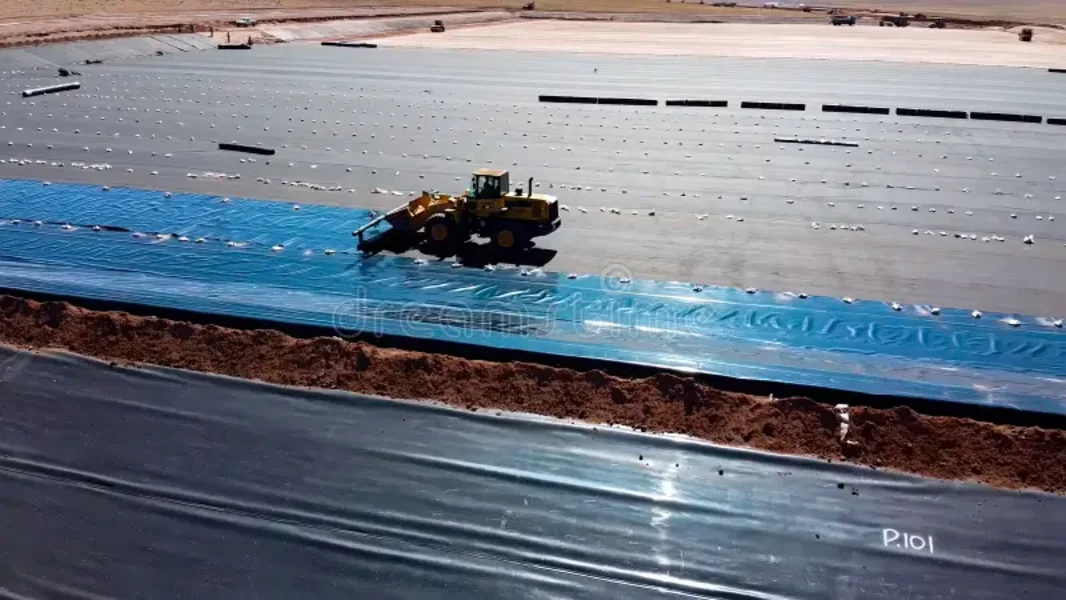
The mining industry is one of the largest consumers of thick and heavy-duty geomembranes. In the heap leaching process, mineral ores are stacked on massive pads equipped with geomembranes, and acidic or cyanidic solutions are sprayed over them. The geomembrane must withstand the immense weight of the rocks (sometimes exceeding 50 meters in height) and the corrosive nature of the solutions. In this application, textured HDPE geomembranes are preferred because they generate higher friction and prevent the ore mass from sliding on slopes.
Optimization of Water Resources in Agriculture and Livestock
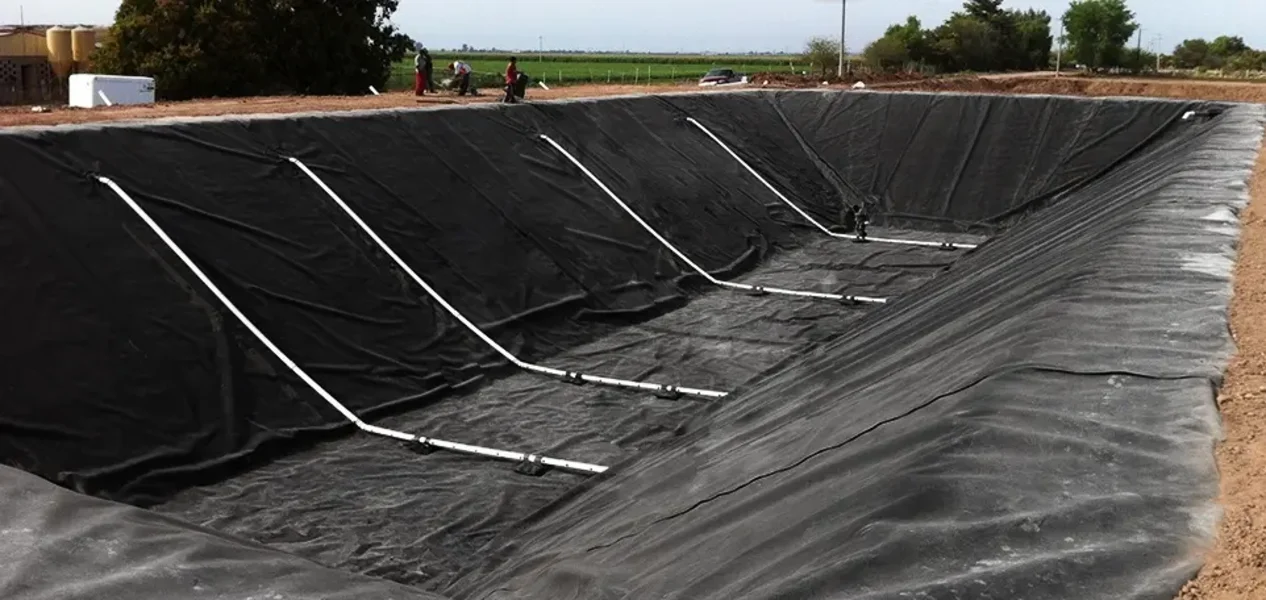
Given the global water crisis, the use of geomembranes in agricultural water storage ponds and conveyance canals has expanded significantly. Unlike earthen or concrete ponds, which face high seepage and evaporation, geomembrane ponds bring water loss close to zero. In aquaculture, geomembranes create a hygienic environment that prevents fish from contacting contaminated soil, facilitating the disinfection and harvesting processes.
Urban Infrastructure and Tunneling
In subway and road tunnel projects, preventing groundwater from entering the tunnel space is critical to maintaining the stability of the structure and electrical equipment. PVC sheets with a signal layer are very common in this sector; the thin colored layer on the sheet reveals the underlying black layer as soon as it is scratched or damaged during installation, allowing inspectors to repair the damaged area before final concrete pouring.
Seaming Technologies and Joint Engineering
Seams are the most critical points in any geomembrane system. A failure in a single seam virtually destroys the integrity of the entire impermeability system. Welding geomembranes is a thermodynamic process that requires precise control of temperature, pressure, and speed.
Hot Wedge Welding Process
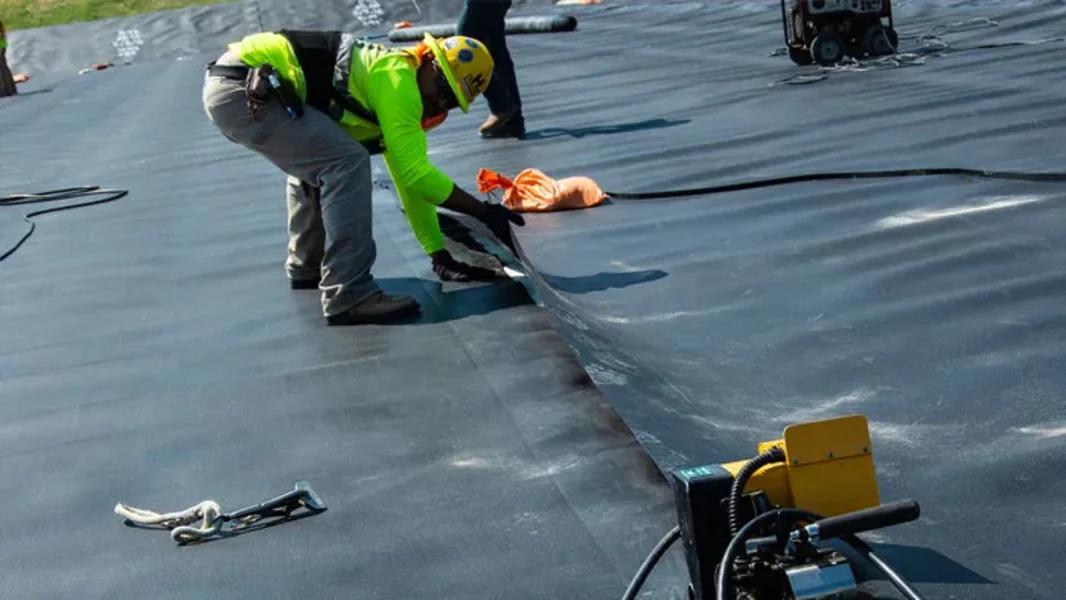
This method is the gold standard for joining polyethylene sheets in large-scale projects. The welding machine features a metal wedge heated by electrical power to temperatures between 300 and 420 °C. The wedge moves between two overlapped layers, melting the polymer surface. Immediately behind the wedge, pressure rollers squeeze the two molten layers together to establish a molecular bond. The use of a "dual wedge" creates two parallel weld tracks with an empty channel in the middle, which is used for air pressure testing to verify weld integrity.
Extrusion Welding Process (Extrusion Fillet)
In cases of repairs, joining irregular edges, or connecting the sheet to concrete structures and pipes, a hand-held extrusion welder is utilized. This device melts a polymer welding rod (of the same material as the sheet) and extrudes it as a hot bead onto the seam edge. Before extrusion, the sheet edges must be physically ground to remove the oxidized surface layer and form a better bond.
Hot Air Welding and Chemical Bonding
For thinner sheets or materials such as PVC, hot air blowers are used, which establish the connection by softening the edge surfaces and applying manual pressure. In some applications, PVC can also be cold-welded using chemical solvents, where the solvent dissolves the polymer surface and, upon evaporation, integrates the two layers seamlessly.
Economic Comparison: Geomembrane versus Conventional Methods
Replacing concrete or clay with geomembranes has shifted the paradigm of civil engineering costs. Although the unit material cost might appear higher, a Total Cost of Ownership (TCO) analysis proves the superiority of geomembranes.
Capital Expenditures and Execution Time
The use of geomembranes reduces execution costs by an average of 25% to 60%. A large portion of this savings stems from its extremely high installation speed; a professional team can install up to 5,000 square meters of geomembrane daily, whereas executing the same area with reinforced concrete takes weeks. Furthermore, geomembranes do not require heavy and expensive foundations and can be installed directly on compacted soil.
Operational Costs and the 25-Year Life Cycle
Over a 25-year period, concrete structures develop cracks due to ground settlement and freeze-thaw cycles, making their repair costs exorbitant. Water leakage from concrete cracks in large reservoirs can cause millions of dollars in economic losses annually. In contrast, high-quality geomembranes (such as HDPE), with a useful lifespan exceeding 50 years and negligible maintenance costs, return the investment in less than 8 years solely through water savings.
Carbon Footprint and Environmental Sustainability
Cement production is one of the most polluting industrial processes. Studies show that the use of geomembrane systems results in an 80% to 95% lower carbon footprint compared to equivalent concrete structures. Moreover, polymeric geomembranes are recyclable at the end of the project's life, whereas the demolition of concrete structures leads to the accumulation of a massive volume of non-recyclable waste.
Degradation Mechanisms and Failure Risk Management
Understanding the life-limiting factors of geomembranes is essential for project managers and supervising engineers to prevent catastrophic failures.
Environmental and Weather-Induced Degradation
Prolonged exposure to UV radiation leads to "photo-oxidation," which breaks polymer chains and renders the sheet brittle. High temperatures (exceeding 60 °C) also accelerate the depletion of antioxidants, doubling the rate of degradation. In cold regions, freeze-thaw cycles can induce severe thermal stresses at weld points, leading to seam separation.
Chemical Attacks and Catalytic Oxidation
Although polyethylene exhibits high resistance, certain hydrocarbons, solvents, and oils can cause swelling and a reduction in mechanical properties. In some mines, the presence of heavy metals can act as a catalyst, severely accelerating the polymer oxidation process. A thorough review of the fluid's chemical compatibility with the polymer type and its antioxidant package is mandatory prior to sheet selection.
Workmanship Defects and Mechanical Damage
Many failures result from human error during installation. Surface scratches caused by dragging the sheet over sharp stones can reduce the sheet's strength by up to 50%. Additionally, excessive temperature during welding creates a weak Heat-Affected Zone (HAZ) prone to premature cracking. The migration of underground gases beneath the geomembrane layer can also lead to the phenomenon of "whales" (bubbling or billowing of the liner), which threatens the integrity of the hydraulic structure.
Maintenance, Inspection, and Repair Protocols
A geomembrane system requires a documented maintenance program to preserve its efficiency.
Periodic Inspections and Smart Monitoring
Visual inspections should be conducted to identify punctures, discolorations, seam separations, and sediment accumulation. In critical projects, the use of electrical leak location systems (Liner Integrity Surveys) is recommended, which can detect holes as small as a pinhole beneath water or soil layers.
Vegetation Management and Biological Control
The growth of plant roots and weeds beneath or around the geomembrane can create localized point pressure and puncture the sheet. The use of standard herbicides and regular scraping of the pond bed to prevent the growth of algae and bacteria that might damage the polymer layer is essential.
Emergency Repair Methodology
If a leak is detected, the repair steps must be executed precisely:
- Preparation: Drain the fluid, dredge, and completely dry the damaged area.
- Cleaning: Clean the surface with detergents and remove the surface oxidized layer.
- Patching: Use a patch of the same material and thickness as the original sheet, with dimensions extending at least 15 cm beyond the damaged area on all sides.
- Welding: Perform extrusion welding or use specialized polymeric adhesive tapes depending on the type of material.
Conclusion and Infrastructure Development Outlook
Comprehensive analyses indicate that geomembranes are not only an economic choice but an engineering necessity for transitioning toward sustainable and impermeable infrastructure. The ability of these materials to contain hazardous pollutants, preserve scarce water resources, and reduce civil project costs has placed them at the top of the strategic materials list. However, the success of a geomembrane system depends entirely on a chain of factors, including the correct selection of the polymer (HDPE for chemical resistance, PVC for flexibility), adherence to GRI standards in manufacturing, and strict execution of welding and testing protocols. With technological advancements and the emergence of nanocomposites and smart geomembranes, it is expected that the future will witness sheets with lifespans exceeding 100 years and self-diagnostic capabilities, elevating environmental safety to unprecedented levels. Ultimately, investing in the technical knowledge of installation and maintenance remains the key to maximizing the potential of this polymer technology in the current century.